My dad likes to use the cheesy pun "time flies like and arrow, fruit flies like a banana". While it caused us all to groan, the first half of the pun is accurate beyond belief. It is a singular anomaly of life that, as much as we wished otherwise, time continues to flow despite our busy schedules. It can be easy for those of us involved in a production to forget that there is still a company surrounding us continuing on with it's day to day business and we thought this might be a good time to highlight some of the activities going on.
This past weekend Lyric Theatre hosted auditions for the next two shows. This summer's discovery series production of The Prince of Pilsen and next fall's main-stage production of Gilbert & Sullivan's Utopia Limited. We had a turnout of around 80 people for these auditions, a record for the company, and our production staff was very pleased with the quality of singers available. Next weekend will be call-backs for both shows, and the production staffs will be continuing to meet to discuss casting and artistic vision, and we look forward to presenting these shows to you in the coming months.
The Board of Directors continues it's mission to oversee the running of the company and to work on it's many committees. We strive to continually monitor the financial and holistic health of the company and to
make strides into new methods of meeting the needs of our audience and performers. In addition, we sent out our membership renewal letters and are in the process of prepping for our annual membership meeting on May 4th. If you are currently a member of the company, you should have received information about the membership meeting in the mail last week. This is a time for us to gather together and share a meal with the whole Lyric family as well as to hear reports from the president of the company and the finance committee. This is also the time when we elect members to the Board of Directors. If you are not a member of Lyric Theatre, but would like to have a voice in shaping the future of the company, information can be found here.
Our Marketing committee is hard at work planning the artwork for the our upcoming season. We are pleased to announce that Jennifer Medeiros, a long time Lyric cast member, will be returning as our graphic designer. She has already worked up some really cool designs and we can't wait to share them with you. We are also working on some cool new forms of marketing for The Mikado and we will be sharing those with you as they happen.
Looking even farther ahead, our Production Staffing committee is in the process of hiring stage directors, music directors, and producers for our next season. We are pleased to announce our production staff for Utopia Limited; Laurie Hupman: producer, Phil Lowery: stage director, Jeff Yaeger: music director, and Neil Midkiff: vocal director.
Phew, that's a lot of stuff I could use a vacation after just writing about it! Mikado rehearsals continue and you will be hearing more about them as we get farther along. As always, you can keep in touch with us on Facebook, Twitter, or our website.
Tuesday, April 15, 2014
Friday, April 11, 2014
Behind the baton
Tonight we spend some time with one of the most recognizable members of a production team, the music director. The music director is responsible for ensuring the cast and the orchestra learns the music and conducts all the shows. The music director is involved in a production from the very start and must be an expert on the music, analyzing and interpreting what is in the score and reconciling it with the stage direction. Our music director for The Mikado is Aaron Schultz. Aaron first joined Lyric Theatre in 2009 as our music director for Yeoman of the Guard, interestingly Yeoman was Aaron's first Gilbert and Sullivan show. Like many of us who did not grow up with G&S, Aaron found out that he really liked the style and has been music director for several shows since then. I asked Aaron to share some of his thoughts on how the rehearsals have been going;
"Rehearsals started off great with the first all-cast gathering. The main issue with the evening was the inability of one's stomach to endure the amount of good deserts the mouth wants. Seriously, the cast delivered a fantastic first read, it appears that not only is the cast gifted in talent, but also a friendly group of super nice folks. I am very excited to work with them! And indeed, after two days thus far, I have not been disappointed. I had scheduled the leads on the first night over a four hour span. The goal was to bring people in and out in such a way as to touch at least half of all lead song moments, while requiring a minimal amount of time. The arrivals and departures worked, but the leads were so strong that we got through what I thought would be 4 hours of music in less than 3."
Not to be left out in the cold, Aaron has this to say about the chorus; "Four days in and, wow, the chorus has learned a LOT of music over 7.5 hours. We have pretty much 95% of the chorus measures, including combined, men's only, and women's only. Even though there is no substitute for seemingly dull parts banging out, in the end I feel that these early rehearsals have still managed to create some real music and enable some shared performance experiences!"
About The Mikado, "The Mikado deserves its reputation as a top tier G&S show, and indeed a top tier English opera. While it may not have the overt beauty of Puccini, the drama of Wagner, or the 'greatness' of Verdi (in my opinion, The Mikado does not aim for this). The opera does span the range of G&S and is fun to work on and a delight to perform"
As always, you can keep in touch with us on Facebook, Twitter, or our website.
"Rehearsals started off great with the first all-cast gathering. The main issue with the evening was the inability of one's stomach to endure the amount of good deserts the mouth wants. Seriously, the cast delivered a fantastic first read, it appears that not only is the cast gifted in talent, but also a friendly group of super nice folks. I am very excited to work with them! And indeed, after two days thus far, I have not been disappointed. I had scheduled the leads on the first night over a four hour span. The goal was to bring people in and out in such a way as to touch at least half of all lead song moments, while requiring a minimal amount of time. The arrivals and departures worked, but the leads were so strong that we got through what I thought would be 4 hours of music in less than 3."
![]() |
| The men's chorus hard at work under Aaron's baton |
Not to be left out in the cold, Aaron has this to say about the chorus; "Four days in and, wow, the chorus has learned a LOT of music over 7.5 hours. We have pretty much 95% of the chorus measures, including combined, men's only, and women's only. Even though there is no substitute for seemingly dull parts banging out, in the end I feel that these early rehearsals have still managed to create some real music and enable some shared performance experiences!"
About The Mikado, "The Mikado deserves its reputation as a top tier G&S show, and indeed a top tier English opera. While it may not have the overt beauty of Puccini, the drama of Wagner, or the 'greatness' of Verdi (in my opinion, The Mikado does not aim for this). The opera does span the range of G&S and is fun to work on and a delight to perform"
As always, you can keep in touch with us on Facebook, Twitter, or our website.
Tuesday, April 8, 2014
A 2nd Trombone! - The music of The Mikado
![]() |
| The Schirmer edition of score |
I thought it might make an interesting point to talk about the different versions of the score as well as some interesting facts about one of the most famous songs in the show. As you might expect of a show like The Mikado, there are multiple versions of the score and one of the most interesting is the "First Night Edition" that still survives in some places. It is not very often performed and there are some major differences between that and the Schirmer score we will be using. Most notably, is the fact that Yum-Yum's aria "The sun whose rays" was originally in Act 1 of the show. However, the original Yum-Yum complained that she would not be able to do the song justice so shortly after "Three little maids" and "So please you sir" and so it was moved to Act 2 just after the opening chorus. In addition, some minor changes were made including; removing a verse from "Were you not to Ko-Ko plighted" and "So please you sir" was originally a quintet with Yum-Yum, Pitti-Sing, Peep-Bo, Pooh-Bah, and Pish-Tush, however Pish-Tush has left the stage earlier with the chorus and with no convenient way to bring him back, the part is often cut from productions. In addition the "Little List" song was originally later in Act 1 then where it lies now and had a chorus refrain, the music for which was left out of the autograph score making it very difficult to add back into the show.
| Jordan Eldgredge as Ko-Ko |
As some day it may happen that a victim must be found,
I’ve got a little list — I’ve got a little list
Of society offenders who might well be underground,
And who never would be missed — who never would be missed!
There’s the pestilential nuisances who e-mail you with spam —
Like “bankers” from Nigeria whose goal it is to scam.
The loud-mouthed TV dietitians yelling that you’re fat —
They’ll send you some concoction that’ll slim you just like that!
The telephone solicitors who simply won’t desist —
They’d none of ’em be missed — they’d none of ’em be missed!
He’s got ’em on the list — he’s got ’em on the list;
And they’ll none of them be missed — they’ll none of them be missed.
There’s the operetta singer, and the others of his race,
The off-pitch soloist — I’ve got him on the list!
The people who smoke cigarettes and puff them in your face —
They never would be missed — they never would be missed!
The CEO who runs his enterprise into the ground,
But walks away with millions when the whole affair is found,
All fat cats working Wall Street and the bonuses they flout,
And the idiotic Senators who help to bail them out,
And that singular anomaly, the sub-prime mortgagist
I don’t think he’d be missed — I’m sure he’ll not be missed!
He’s got him on the list — he’s got him on the list;
And I don’t think he’ll be missed — I’m sure he’ll not be missed.
And the people who pollute TV with shows that they contrive,
The exhibitionist — I’ve got him on the list!
The people who cause accidents when texting while they drive,
They’d none of ’em be missed — I wish they’d all desist.
The talk show host who claims to be so balanced and so fair,
But never is objective when his show is on the air,
Montgomery Theater renovators canceling our shows —
Just how this place will look next year — well, heaven only knows!
And all the social Twitter Facebook MySpace Friendster-ists
I don’t think they’ll be missed — I’m sure they’ll not be missed!
You may put ’em on the list — you may put ’em on the list;
And they’ll none of them be missed — they’ll none of them be missed!
Sunday, April 6, 2014
Special Report: Live from the Mikado potluck and read through
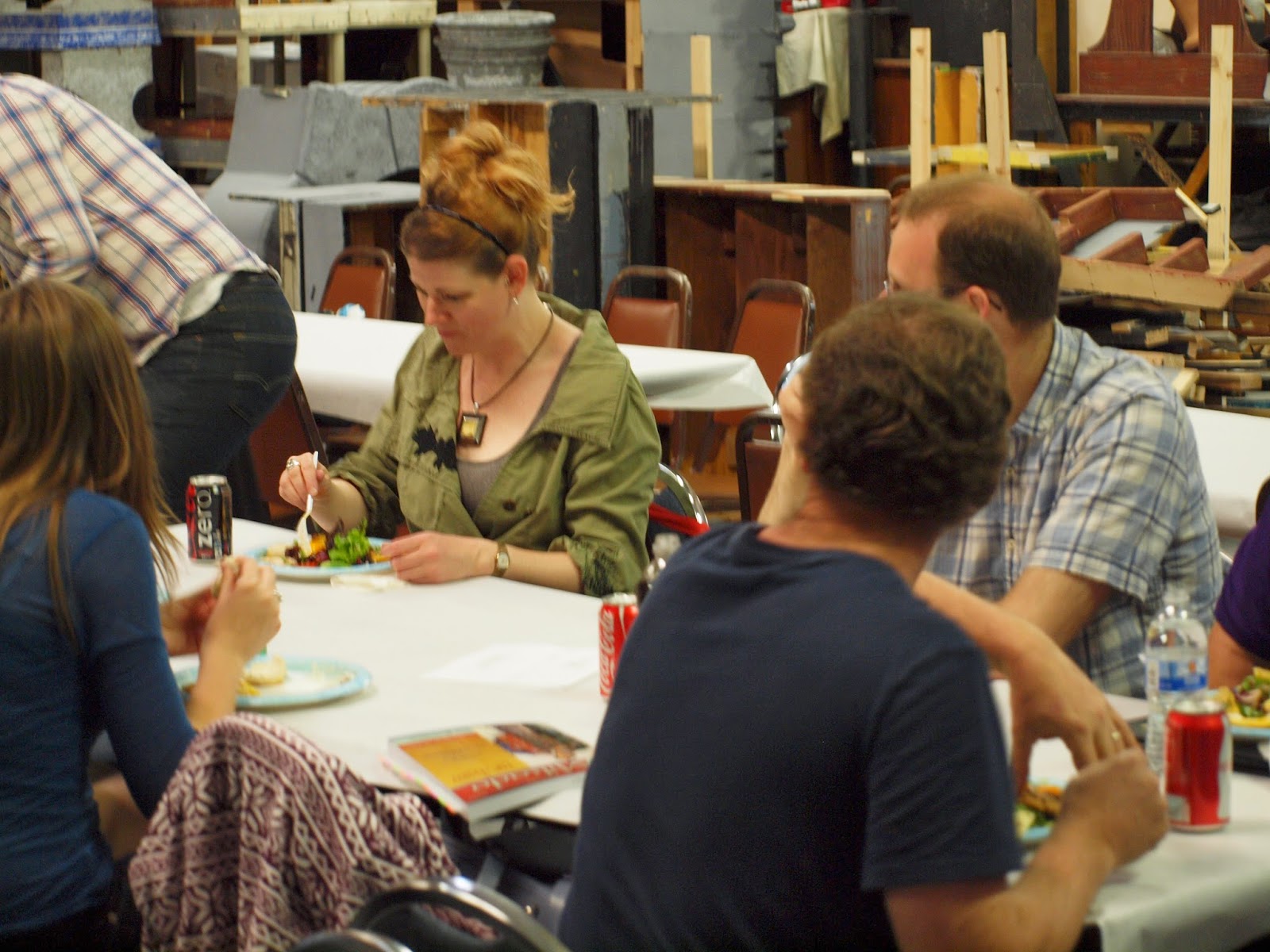
Tonight we gather the cast and production staff for a time honored tradition at Lyric Theatre. Before every show rehearsal period, we get together and share a meal followed by a read through of the show. The point of this event is to give our cast a chance to meet each other and socialize before we dive into rehearsals. It is a night of fun for all and the top off is the read through where our cast sings through the show often with hilarious over acting. Tonight is no exception with bouts of raucous laughter rising off the rehearsal floor every few minutes. I am happy to announce that this is a highly enthusiastic cast and they are excited to show you what they are going to make of the old classic. We look forward to presenting you this show in a short 10 weeks!

As always we encourage you to keep in touch with us on Facebook, Twitter, and our website.
Thursday, April 3, 2014
So you want to be a star; first you must audition
Every show at Lyric Theatre begins with the audition process, a time when the directors and producer gather together the best talent in the area and force them to compete for our approval. I'm kidding of course, we are always grateful for the high level of talent we see at auditions and the process of casting a show is one of the most difficult parts of the job. For the Mikado, we had over 50 people audition for us, each one seemingly more and more talented. Of those who auditioned we had to cast a show of just 9 leads and a chorus of 17. As you can imagine, this requires a lot of debate and give and take among the production staff to cast the best person for each role.
For the staff the whole process begins about a month before the audition dates. During this time, we work on creating an audition notice that has a show synopsis along with the lead roles for the show and a short description of each character. That notice is then sent off into the vast expanse of the internet through our mailing list as well as posting to various message boards and Facebook groups dedicated to informing Bay Area actors about audition opportunities. Before anyone knows it, the audition date rolls around and we gather together to listen to each prospective candidate. The directors are listening for musical ability as well as style and natural acting ability, occasionally we will have a "cold reading" where we provide a number of lines from the show and ask each candidate to read one, this is an opportunity for our stage director to see how each candidate approaches a role without any direction. After 2-3 days of auditions, the staff will meet to discuss who will be "called back" for which role. Call backs are where we provide music and dialogue from the show and ask each candidate to prepare this material. Each role will have 2-3 people called back and from those candidates we will cast the show (chorus members are not called back, but cast from the larger pool of candidate).
After call backs production staff begins the arduous task of casting the show. More often than not, we simply wish we could cast everyone who auditioned for us, but unfortunately that is not an option. We will spend hours pouring over our notes about all our candidates and discussing their performance and how they would fit with the artistic vision for the show. As I mentioned earlier, this is a long process and my personal record so far has been 3 o'clock in the morning to fully cast a show! In the end, we contact everyone who auditioned for us and tell them the good news, or in some cases the bad news, and move on to working on other tasks. Next time we will talk about one of those tasks, set design.
Before we go, I wanted to share another perspective of the audition process with you, that of the person auditioning. I asked Ewa Nowicka who most recently stared as the title role of La Périchole with Lyric to tell me a bit about her process of auditioning. Obviously, the first task is to decide if you want to audition for the show, this can be a question of interest in a show, available roles, location of company and performance venue, etc. Assuming you decide to audition the next step is to sign up for an audition slot (Lyric uses an online booking system allowing our candidates to pick the time that works best from our available pool). Then you have to decide what song you are going to audition with; do you want a song from the show that will show off your compatibility with a desired role or do you pick a song from another show that shows off your range and acting ability. Finally, no matter how many times you audition there is always the challenge of working with a new pianist (often you don't know who it will be until you walk through the door) and overcoming your nerves. For all the work actors put into their auditions, they have about 6 minutes to make an impression on the production staff and secure a call back!
As always, you can keep in touch with Lyric Theatre on Facebook, Twitter, or our website. Please consider sharing this blog with your friends and help us share the joy of musical theater with the Bay Area!
For the staff the whole process begins about a month before the audition dates. During this time, we work on creating an audition notice that has a show synopsis along with the lead roles for the show and a short description of each character. That notice is then sent off into the vast expanse of the internet through our mailing list as well as posting to various message boards and Facebook groups dedicated to informing Bay Area actors about audition opportunities. Before anyone knows it, the audition date rolls around and we gather together to listen to each prospective candidate. The directors are listening for musical ability as well as style and natural acting ability, occasionally we will have a "cold reading" where we provide a number of lines from the show and ask each candidate to read one, this is an opportunity for our stage director to see how each candidate approaches a role without any direction. After 2-3 days of auditions, the staff will meet to discuss who will be "called back" for which role. Call backs are where we provide music and dialogue from the show and ask each candidate to prepare this material. Each role will have 2-3 people called back and from those candidates we will cast the show (chorus members are not called back, but cast from the larger pool of candidate).
After call backs production staff begins the arduous task of casting the show. More often than not, we simply wish we could cast everyone who auditioned for us, but unfortunately that is not an option. We will spend hours pouring over our notes about all our candidates and discussing their performance and how they would fit with the artistic vision for the show. As I mentioned earlier, this is a long process and my personal record so far has been 3 o'clock in the morning to fully cast a show! In the end, we contact everyone who auditioned for us and tell them the good news, or in some cases the bad news, and move on to working on other tasks. Next time we will talk about one of those tasks, set design.
![]() |
| Ewa as Perichole photo courtesy Steve Stubbs |
As always, you can keep in touch with Lyric Theatre on Facebook, Twitter, or our website. Please consider sharing this blog with your friends and help us share the joy of musical theater with the Bay Area!
Monday, March 31, 2014
Who are you and what do you do: a producer's tale
That's me all spiffy (the joys of the musician life) and I'm sure some of you are wondering who I am and how I got involved with Lyric Theatre, as well as what my role of producer is with a show like The Mikado. To formally introduce myself, my name is Justin Horn and I have been with Lyric Theatre since 2005 when I joined the orchestra (percussion) for Gilbert and Sullivan's Ruddigore. Since then I have played every main stage show with the exception of 1776; I also started to work with other committee's in Lyric including working on marketing. In 2013, Ruddigore came around again and our producer was looking for some help and a person he could train to become a full producer with the company. I have always been interested in the behind the scene's aspect of theater and so I volunteered for the role, it turned out to be a tremendous amount of fun and two shows later, here I am!
But what does a producer actually do? I'm sure the majority of people will be familiar with the term producer from movies and live theater and you may even know that producers are considered to be the "head" of a production. To help you understand how the role of producer works with Lyric Theatre, let's jump back in time to the very beginning of a production. Some of you may not know this, but a production like The Mikado begins one to two years before it ever reaches the stage. The very first step is for our repertoire committee to meet and work out our season for the next year. They will consider many factors including; popularity of show, when it was last performed, demand inside the company to mount a production, etc. After approval by our board, the process moves into the hiring committee. This group looks at potential directors and will interview and hire a stage and music director. It is usually at this point that a producer is hired as well. From that point forward the producer is charged with making a production happen.
One of the first things a producer needs is to gather the remainder of the production staff, this consists of people like; stage managers, lighting designers, set and costume designers, props managers, and other technical staff. This list can be quite large depending on the show and it is truly amazing that even six to eight months before rehearsals begin about ten people are already hard at work planning and organizing. Over the coming weeks we will be exploring what some of these positions entail and you can see how much thought and care are put into areas many of us don't think about.
In addition to hiring a production staff the producer is in charge of budgeting a show. This is a delicate task that requires allowing the directors and designers the freedom to realize their artistic vision while keeping expenditures down. It is not my favorite part of the job, but a necessary one. From this point, everything kicks into high gear and multiple meetings are called to prepare for auditions and rehearsals. There is a dinner meeting with the music and stage director to talk about the vision for the show and to begin organizing auditions. Speaking of auditions, we will discuss those in more depth on the next blog entry, it is an interesting process and I want to do it justice. After auditions there is a long process of contacting everyone who has been cast and beginning the process of organizing rehearsal schedules.
Finally, we are ready to gather the full production staff for a meeting to get everyone started on their tasks and layout the general feel for the productions. As producer, I really have the freedom to set the tone for the production and a good producer can make or break a production staff and through them a cast. After all this rehearsals finally start and we still have ten weeks to go!
So there it is, the whole process of being a producer from start to the beginning of rehearsals. The job doesn't end there, I will continue meeting with the staff to make sure we are on track as well as check in with the cast to see how rehearsals are going and to help solve any issues that arise. I will end this post by saying that there is an old saying "jack of all trades"...we'll ignore the second part of the idiom for now. What I mean by this is the job of producer is always evolving and there will always be something that was not planned for, so perhaps my biggest job is to be flexible and attentive trying to anticipate issues and resolve them and going forward to help the company better plan for new challenges.
Thank you so much for checking out our blog, as always you can keep in touch with us on facebook, twitter, or our website. I hope you will consider sharing this blog with your friends and help us build excitement as we embark on another production!
-Justin Horn, Producer "The Mikado"
Friday, March 21, 2014
Welcome to a look behind the curtains at Lyric Theatre.
The goal of this blog is to provide you with a deeper understanding of what it takes to stage a production. We will be updating this blog with information about the process of staging a production as well as thoughts from our production staff. Check back often and share with your friends!
Be sure to check out our website for more information on our shows www.lyrictheatre.org
You can also find us on Facebook: Lyric Theatre of San Jose
or follow us on Twitter: Lyric Theatre SJ
We hope you find this to be informative and interesting and always remember to support local community theater!
-Justin Horn, Producer "The Mikado"
Subscribe to:
Posts (Atom)